

Pixels and Permanence
Artist and designer Kleinian on printing screenshots onto stone, wiring rocks for sound, and what future generations might dig up from our digital age.

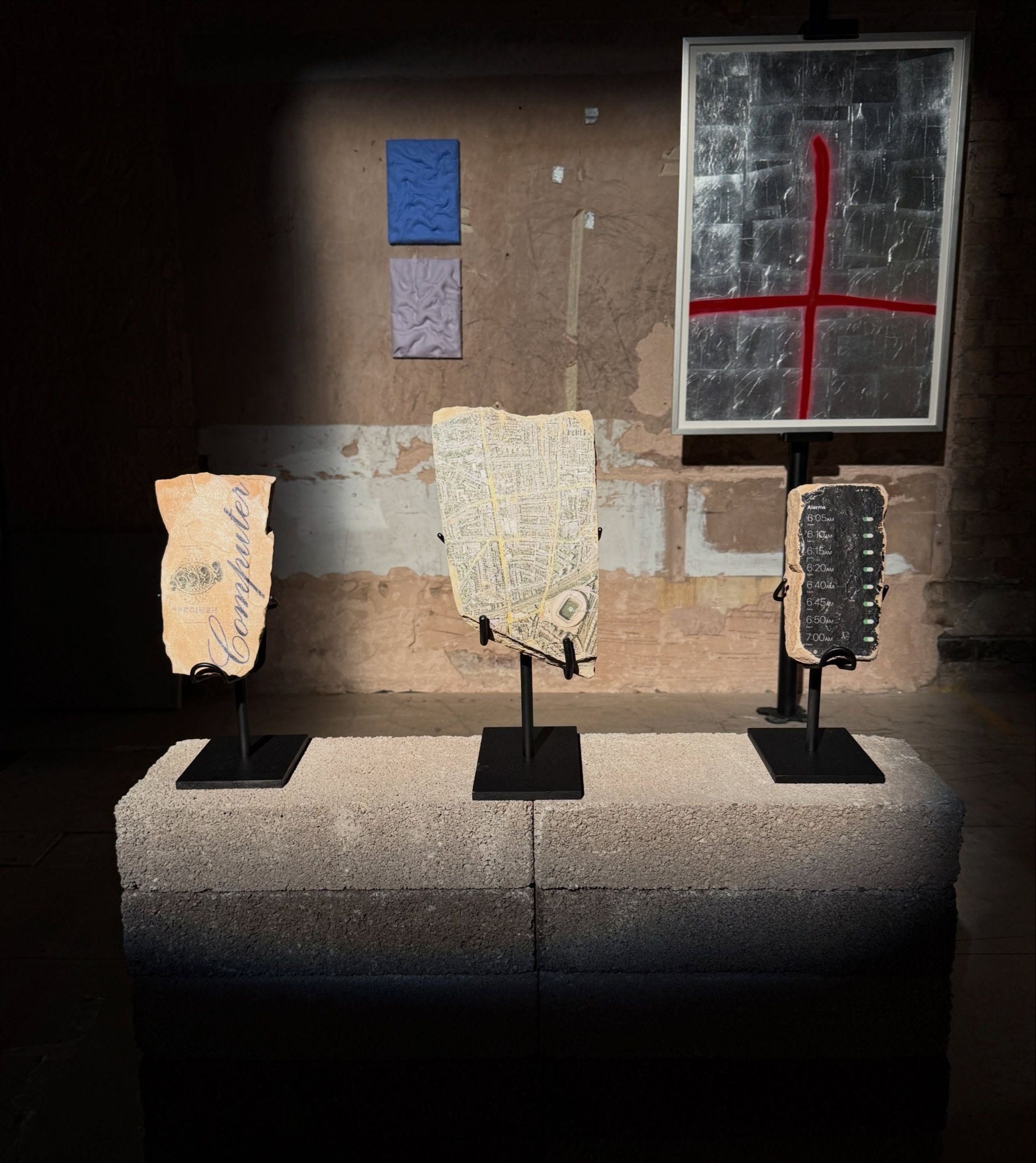
Kleinian is an artist and designer who works somewhere between the digital world and deep time. Things move fast now - a groundbreaking AI model is old news within days, and a cutting-edge device is outdated after one season. The present disappears almost as soon as it happens. Kleinian’s answer is to slow it down - he strips digital objects of their function and presses them into stone until they last.
We sat down with Kleinian to talk about UV printing, electrical engineering, and what a civilization sifting through the wreckage of the AI age might make of us thousands of years from now.
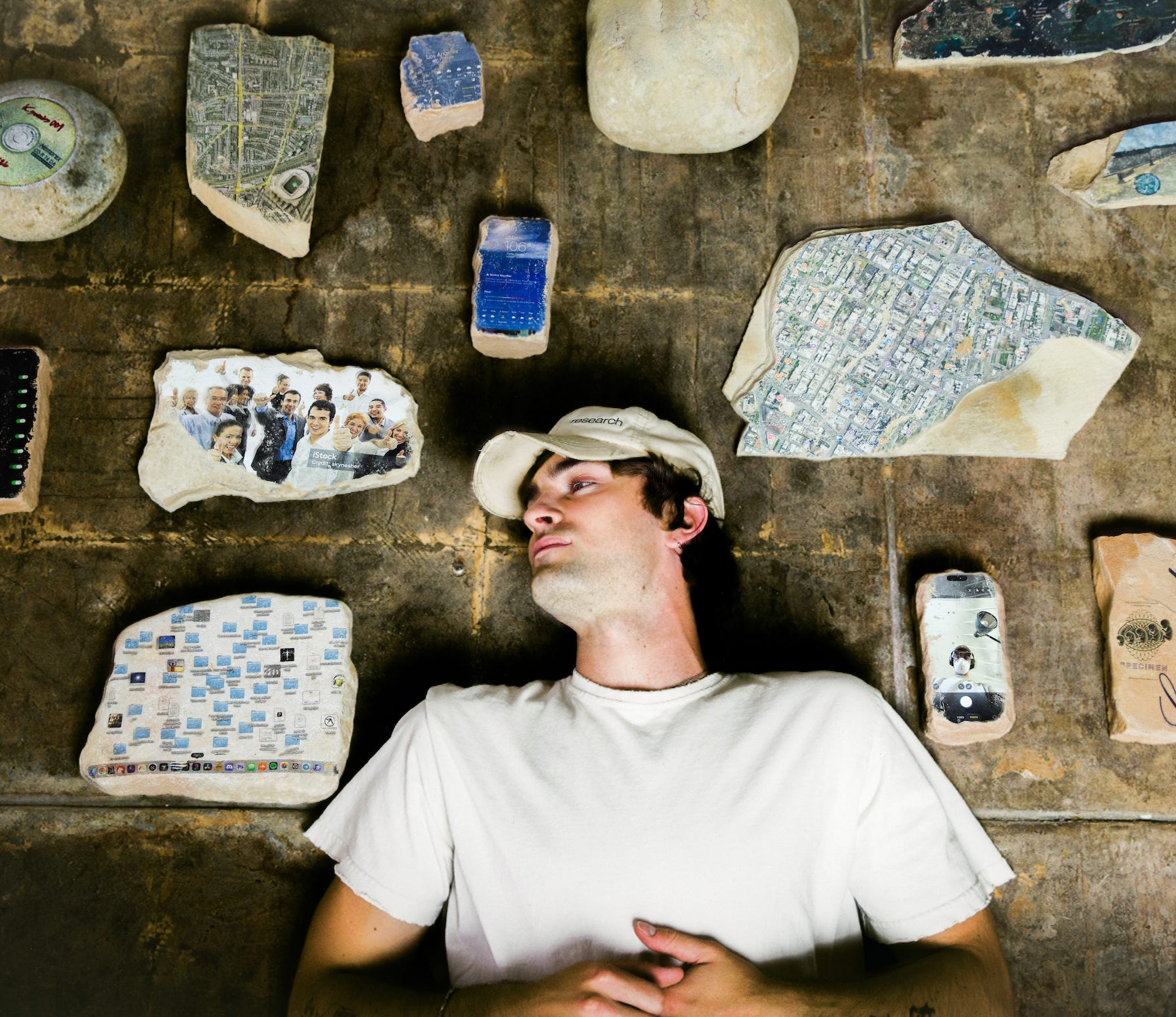
How does each piece begin? Can you walk us through how the idea comes together, from pixels to rock?
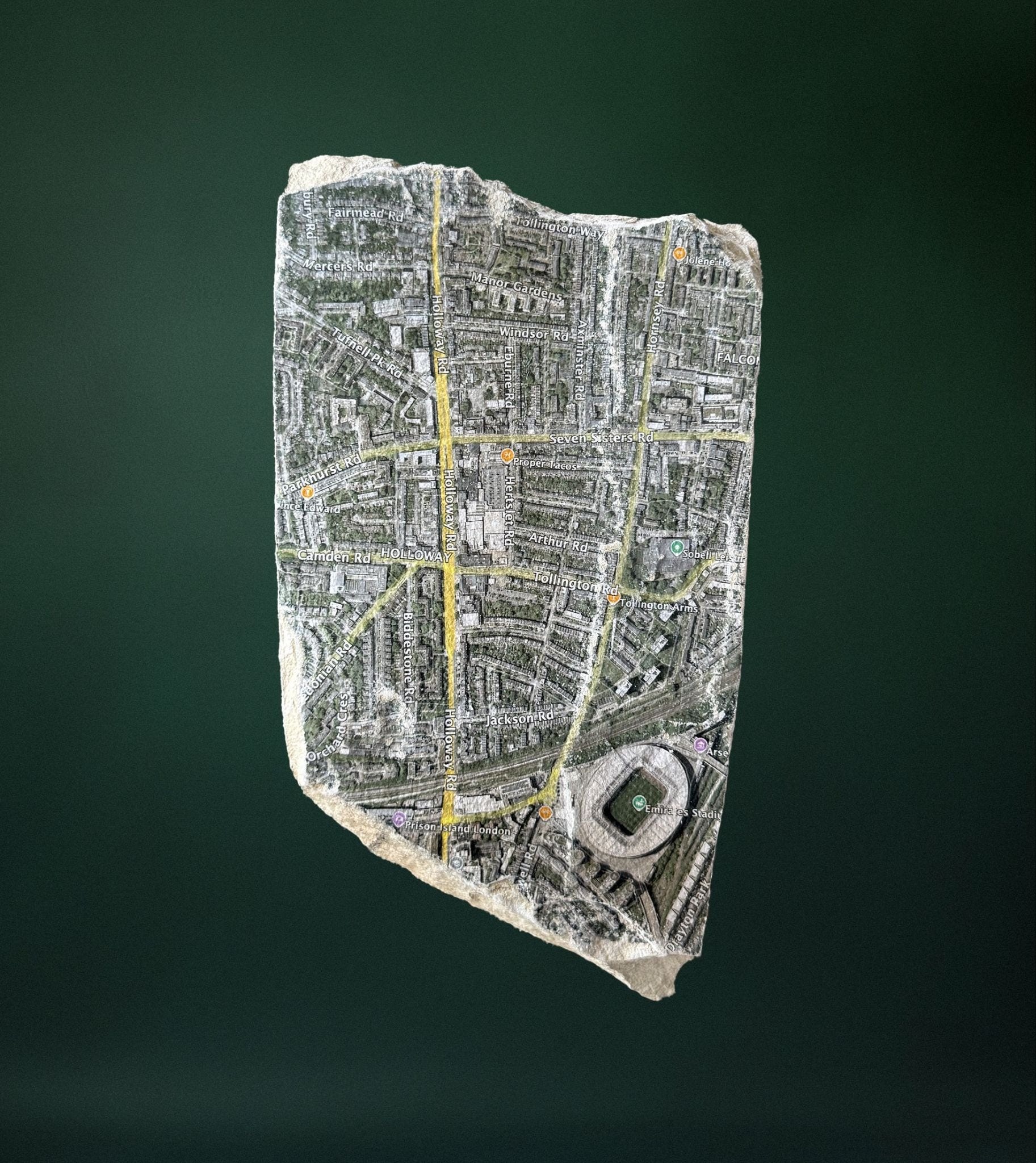
The first piece started as a Photoshop project, a “Google Earth rock.” I found a source for the rocks, photographed one, and Photoshopped a map onto it, then posted the image and mostly forgot about it.
Eventually I built a rough prototype, trying to UV-print directly onto rock with a flatbed printer. The ink was too thick to seep in - it just sat on top, and the prototype fell apart. But I’d filmed it, and that video sat in my camera roll for months. When I finally posted it last October, it went viral on TikTok, and that’s when I decided to actually start making these for real.
I’d just left my job as an art director, so I had free time, and I started working out of a studio with my friend Austin. Time, space, and resources all came together at once.
Now each piece is a balance of what’s culturally resonant, what looks visually striking, and what tells the story I’m after. I source rocks based on vibe, measure the exact dimensions, photograph them, and build a Photoshop artboard to match. Some pieces need real design work to fit a screenshot’s proportions onto an irregular rock; others I build entirely from scratch - the desktop rock, for instance, is a fully custom UI I designed in Figma, folders and all. The FaceTime rock is a fabricated screen built from my own camera roll. It’s a mix of found imagery, original design, and interfaces I build myself.
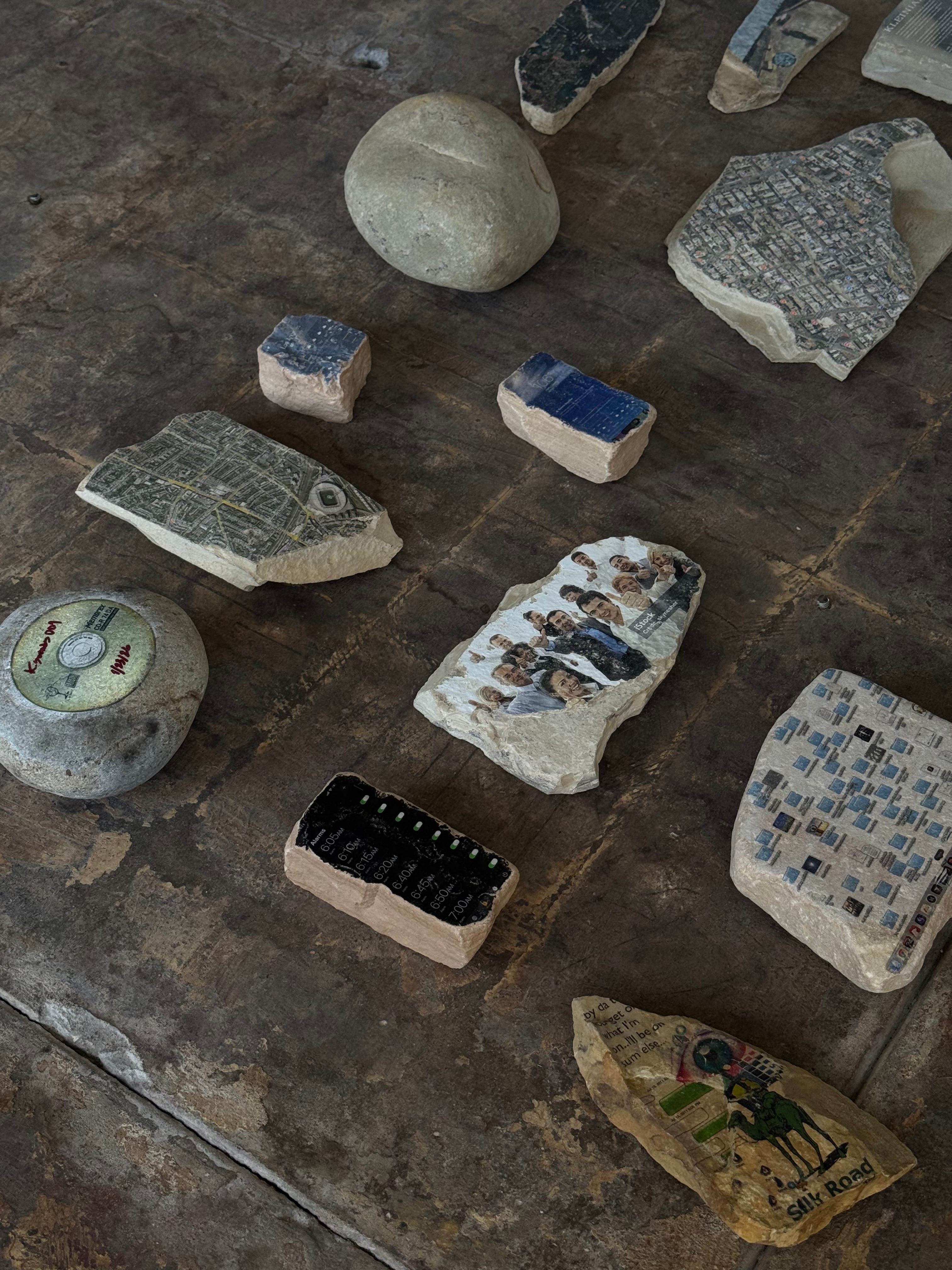
What materials are involved, and what does “calcifying” actually mean in relation to the work?
A lot of what I’ve been perfecting over the past few months is getting the ink to actually seep into the pores of the rock instead of sitting on top - that’s crucial for the pieces to last.
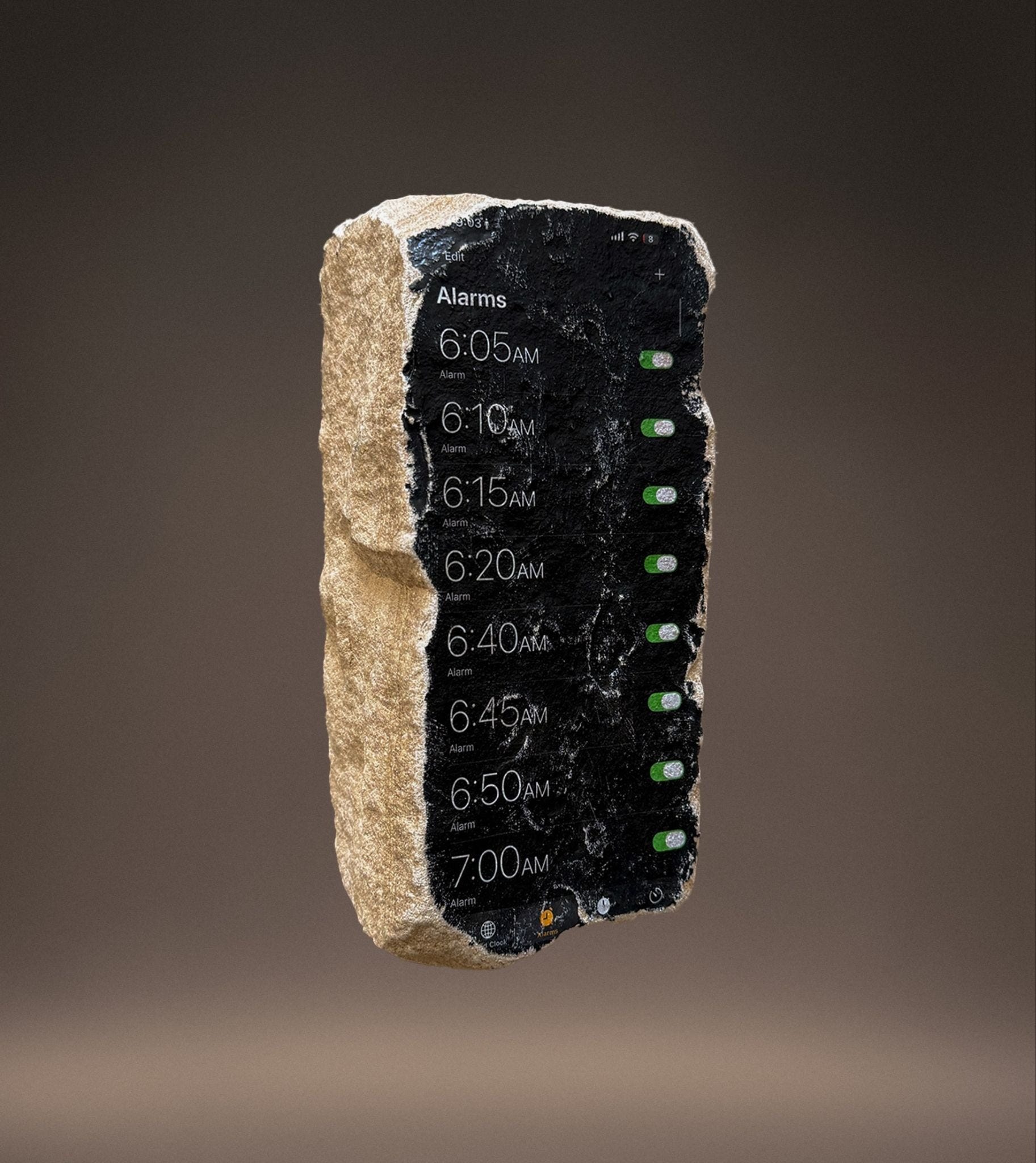
“Calcifying” is about taking moments of UI we see every day and making them physical and permanent. Interfaces change constantly - an early iOS screenshot or the first Windows desktop already reads as nostalgic. But beyond the updates, the pixels lighting up our screens represent one exact moment in time. They’re literally just light, nothing physical.
So the question becomes: how do you preserve light?
What are you working on in the studio right now?
Probably my most ambitious piece yet - a permanent installation for a ceramics museum in Korea. It’s four rocks that together tell the story of the evolution of sound and music: the first is just the natural sounds of Earth, the second traces early human rhythm and instrument-making, the third moves into electronic music and production, and the fourth is AI-generated sound.
Each rock has an audio device embedded inside it, so visitors can plug in headphones and hear a soundscape built specifically for that piece. I’m collaborating with two producer friends on the sound. It’s also my first time doing electrical engineering - learning to solder and build these devices from motherboards, plus fabricating the stands. It’s a big jump in production, and it’s coming together fast, so I’ll be heads-down on it for the next month.
You describe the work as “speculative archaeology.” Can you explain that concept and the audience you imagine encountering these objects?
I’m drawn to the idea of people looking back at us - at who we were as a civilization in 2026. We’re at the forefront of an AI revolution, and so much of our lives happen in a digital realm that’s literally just lights and pixels on a screen.
A lot of how we communicate - and what invokes emotion in us - depends on the context we’ve built up over time. A single emoji can carry wildly different meanings depending on how you’ve seen it used before; memes work the same way. That entire language exists only digitally.
So imagine a post-apocalyptic world with no electronics left, everything buried under rubble - what would actually remain? That question is a lot of where the work comes from.
What do you want to say or preserve about our current relationship with technology, particularly as the line between what is real and fabricated becomes increasingly blurred?
I don’t think I’ve fully explored that question yet. I get a lot of comments from people who assume my work itself is AI-generated, probably because of how surreal the pieces look.
I did make one piece that plays directly with that line: a rock with a QR code that led to a site I coded, where you had to pass a CAPTCHA to prove you’re human. Once verified, AI generated an image of a cave painting onto that rock. I’m interested in keeping work in that space between AI and humans.
Where do you see the work going next?
I want to make machines. I don’t fully know how yet, but I want to start building functional objects, furniture, and mechanical things out of natural materials. The Korea project is my first step in that direction - combining natural materials with electronics and function. Eventually I’d love to put something like an AI bot inside a natural object, like a tree. I don’t know exactly what that looks like yet, but that intersection of natural materials, technology, and function is where I want to keep pushing.
Thanks for reading Own The Future™