

Building the Show
AUTOBODY autobody, on running a gallery like a workshop

Basic.Space is a curated IRL-to-URL shopping experience for what’s new and next in design, art, and fashion. Own The Future™ is where we go deeper - the why - behind the scenes thinking, inspiration, and motivation for how and what we do.
Joseph Santiago-Dieppa and Eli Bucksbaum didn’t set out to open a gallery. They met at a show - Eli was drawn to a frame Joseph had built around a painting he’d later admit to disliking - and somewhere between that conversation and a few studio visits, something clicked.
Joseph was already putting on shows in LA. Eli had just arrived. By the time people started calling them gallerists, they hadn’t thought to disagree. Since then, AUTOBODY autobody has become one of the most quietly exciting spaces in Los Angeles, built less like a gallery and more like a workshop: by hand, on instinct, and with a specific eye for the work that traditional galleries said no to - the too big, the too strange, the too unfinished. These are the objects they make space for.
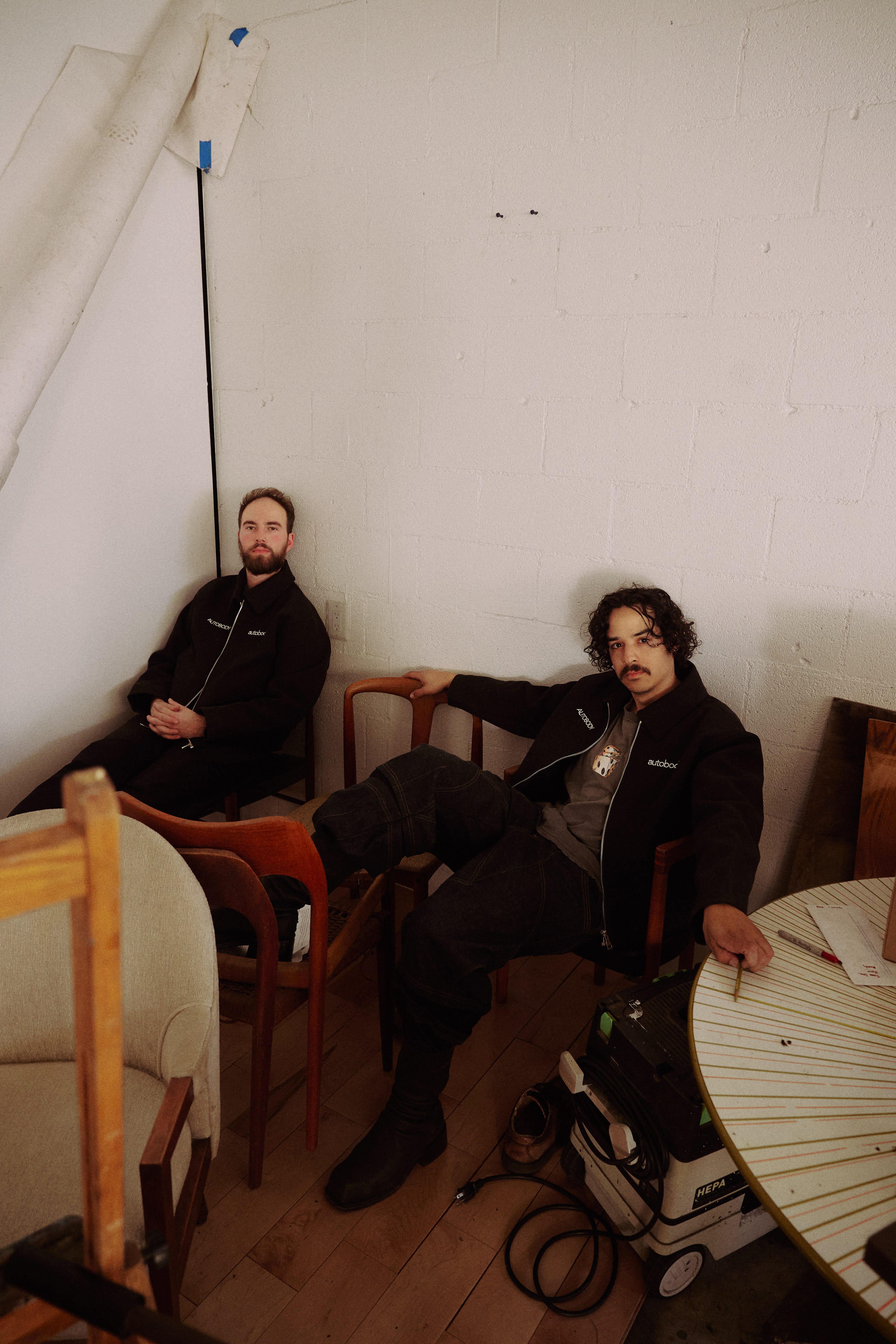
Before we get into the space itself - how did you each develop your eye, and what does curation actually mean to you?
Joseph: The first thing, immediately, is material - walnut, steel, things with a self-expression to them. I like work that demands space. It doesn’t ask permission - it’s just there, occupying. I always think about it this way: if a painting falls over, it won’t kill you. If a sculpture falls over, it will do you harm. That energy is exciting to me. And then it’s the pendulum swing - if I love presence, let me also look for the quiet work, the piece that asks for permission. When those two things come together, the tension creates something.
Eli: My curation has shifted a lot over the last two years working with Joseph. Friction is where we learn - you don’t collaborate with people because it’s easy, you collaborate because it’s hard. But the thing we always come back to is the question: Why? If you don’t have a good enough reason for a piece, it’s a no. We work with people first - if I meet the person and they’re not genuinely interesting, I care about the work a lot less. Excitement is a material within itself.
AUTOBODY autobody shows LA-based artists exclusively. How do you actually find the people you work with?
Joseph: From the very beginning it was clear: we’re an LA-based gallery, so we select only LA artists. Eli and I are both artists ourselves, and we know everyone we show personally. If you’re in LA, in a relationship with us, and we love your work - you’re part of AUTOBODY autobody.
Eli: People expect there’s some reservoir we pull from. That’s not how it works at all. These are the people we go to the bar with, play pool with on Thursday nights at Painters Pool. We’re always in studios and workshops together. Someone mentions a crazy idea and we’re immediately like - can we see it?
You’ve talked about wanting the weird idea – the one sitting at the back of someone’s sketchbook. What does that look like in practice?
Joseph: At the end of every studio visit, when we’re ready to pitch an idea for a show, we tell the artist: we want the thing that’s kind of crazy, kind of dumb - the thing that’s been sitting there because it doesn’t feel viable or sellable. That’s exactly what we want. During the Chair Show, Marley White had this chair that multiple galleries had passed on - said it was just too big. We got so excited. We’ll make space for it. We want it because no one else wants it.
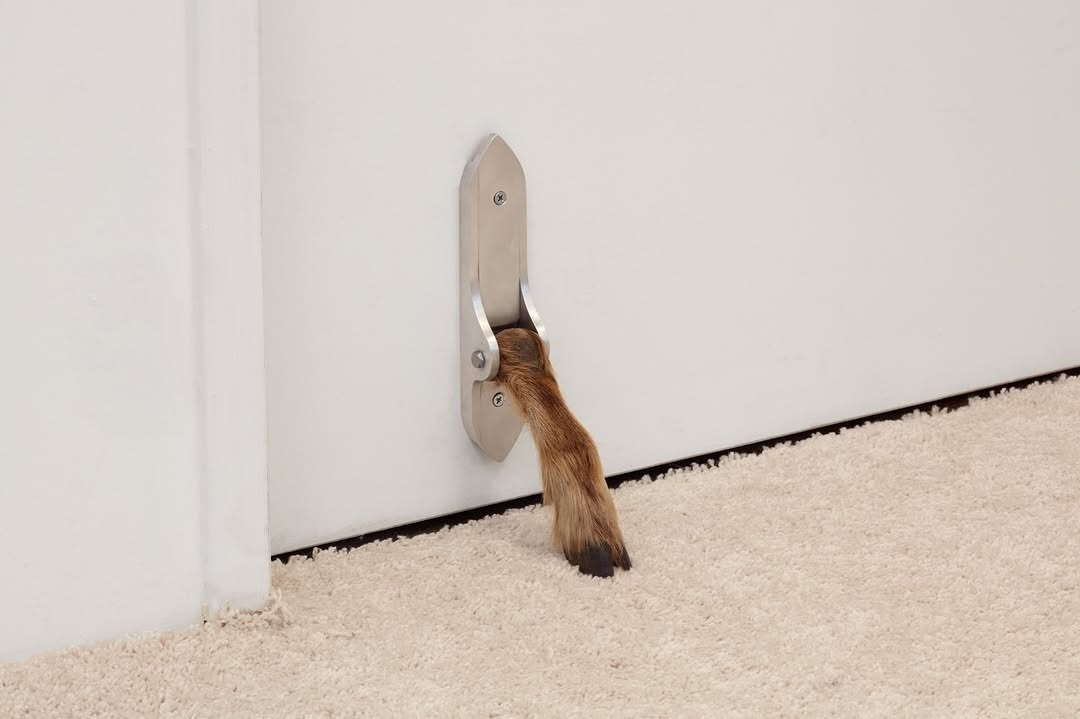
Eli: And not just because no one else wanted it – Marley made this chair wrapped in pig intestines that only she could sit in. That’s exciting. You made this thing, we’ll give you a place to show it. Ideas at the beginning are raw and intense, and most of the time not that sellable. But you have to start somewhere. AUTOBODY autobody gives them that landing spot.
Walk us through how you approached the Basic.Space LA space – from the first conversation to the wedge.
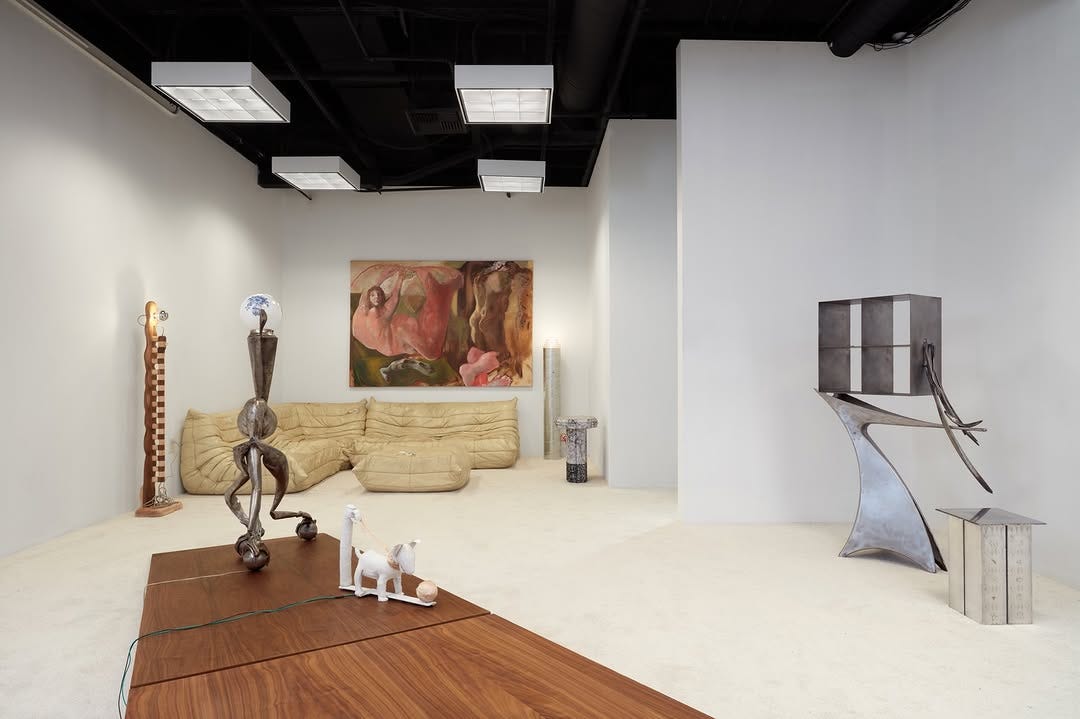
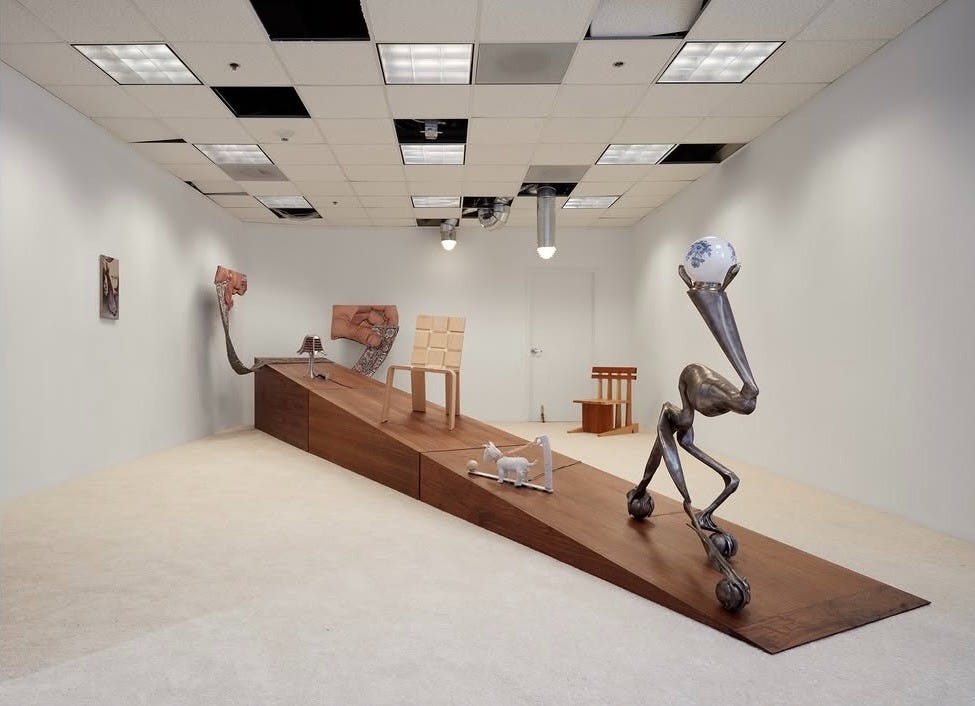
Joseph: When we walked through the space, Eli and I had this two or three hour conversation just sitting in it - what are we going to do? I 3D designed the space and kept asking: what’s the biggest thing we can fit in here? We needed something that could support a floor lamp and a table lamp at the same sight line. So we said, let’s just do a giant wedge.
Eli: After dropping off some work at a collectors house in the Hollywood Hills, Joseph and I decided to go for a walk in the neighborhood. The sun was setting and as we were riffing and ideating for the next build, I had an idea forming in my head – I couldn’t quite put it into words. And then later that night, Joseph sends me an image of a wedge in the space. That’s exactly what I was thinking. Completely separate, completely the same. And then I knew that had to be it.
Beyond the wedge – how did you think about the specific works in the space, and what does each piece bring to the conversation?
Joseph: There’s something really exciting about having art objects and design at an angle. For Ben LaMacchia’s chair, it renders the piece more about its silhouette than its actual function – the design, not the object. There’s a playfulness to it, but you’ve spent months designing and fabricating that joke.
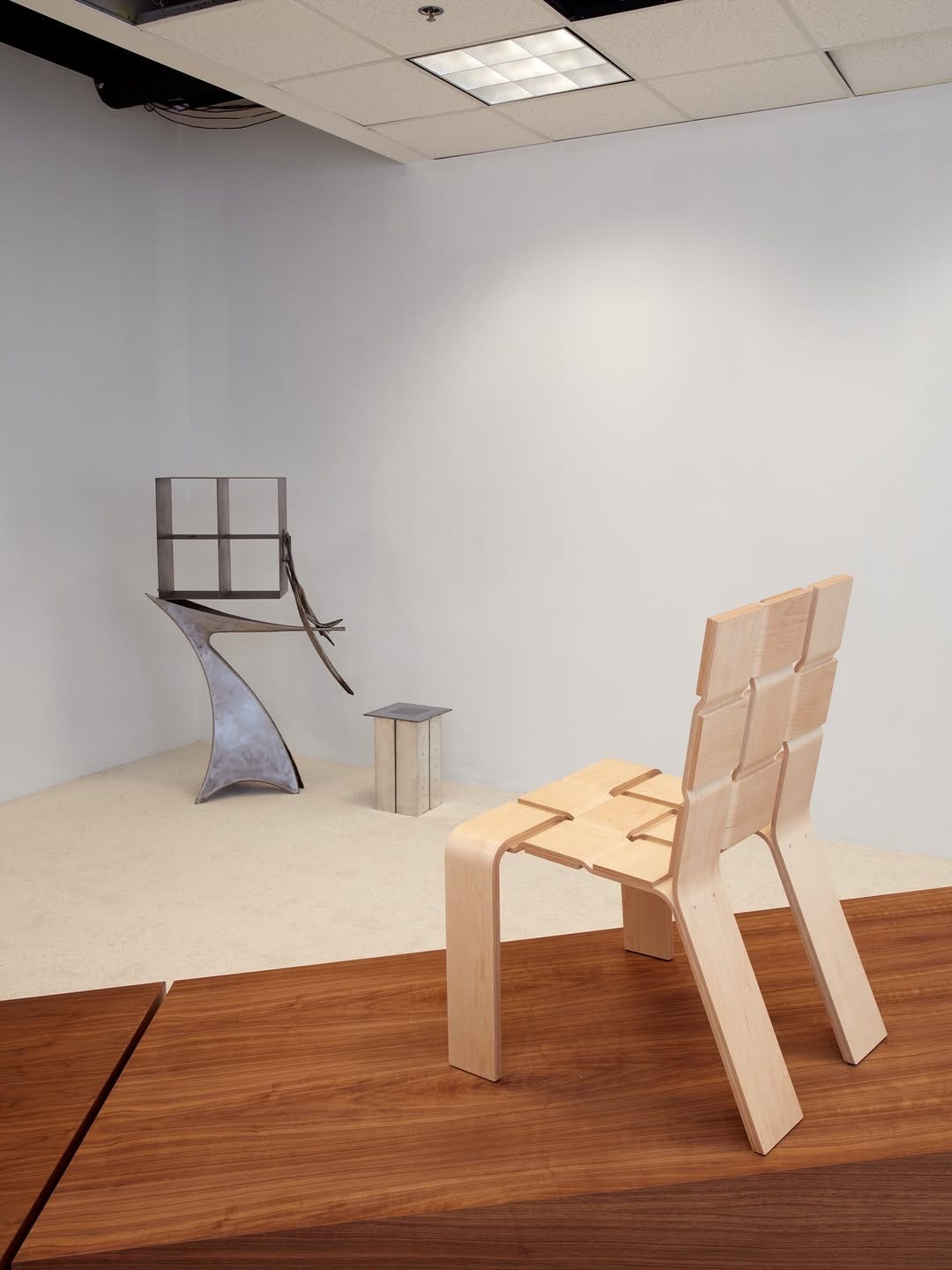
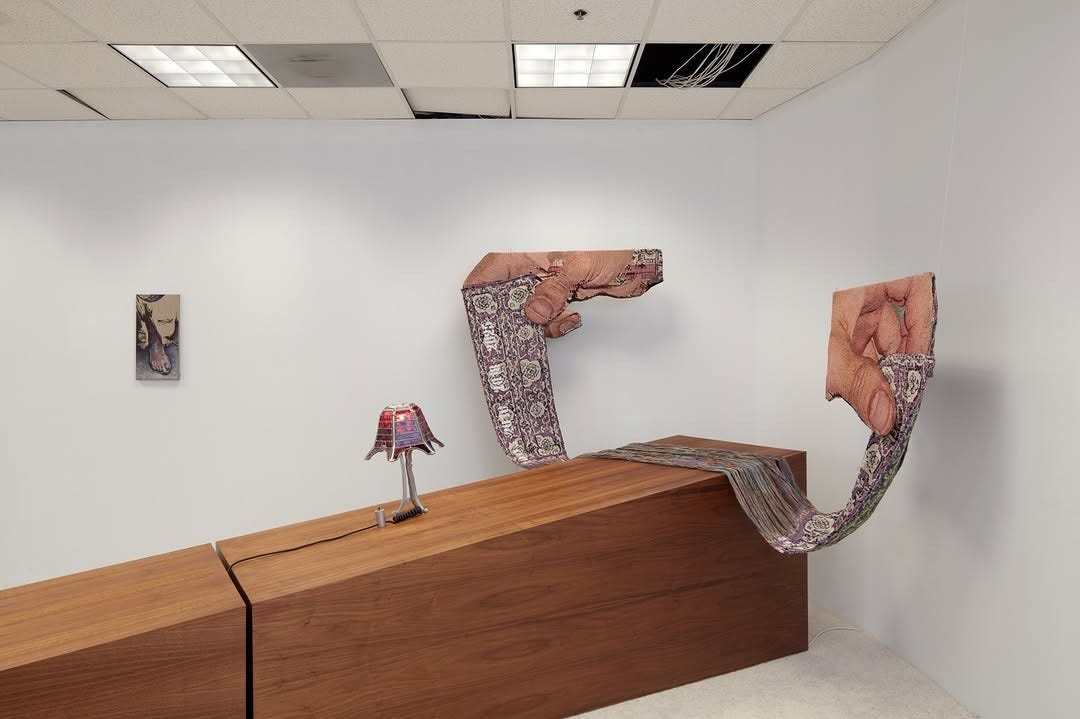
Eli: We think about space first. Always. Once we had the wedge, we started thinking about what work would be conducive to that idea. Joseph’s lamp is stalking over its prey – on that slope, it feels inevitable. And then Emily Clayton’s lamp, which is mind-bogglingly engineered and would obviously live on a flat surface anywhere else, is now on a pretty severe slant. That’s the joke – the absurdity and precision of art and design in the same breath.
Devin Feldman’s HVAC piece feels like a perfect example of what you’re drawn to curatorially. Can you talk about that work?
Joseph: That piece quoted the space perfectly – the industrial, the office core – but with a playful touch. I’ve had people ask, “Was that already there?” When you make something so integrated into its environment that people start questioning whether it was always there, but it’s slightly off — that’s where life and art collide. That’s what I’m always chasing.
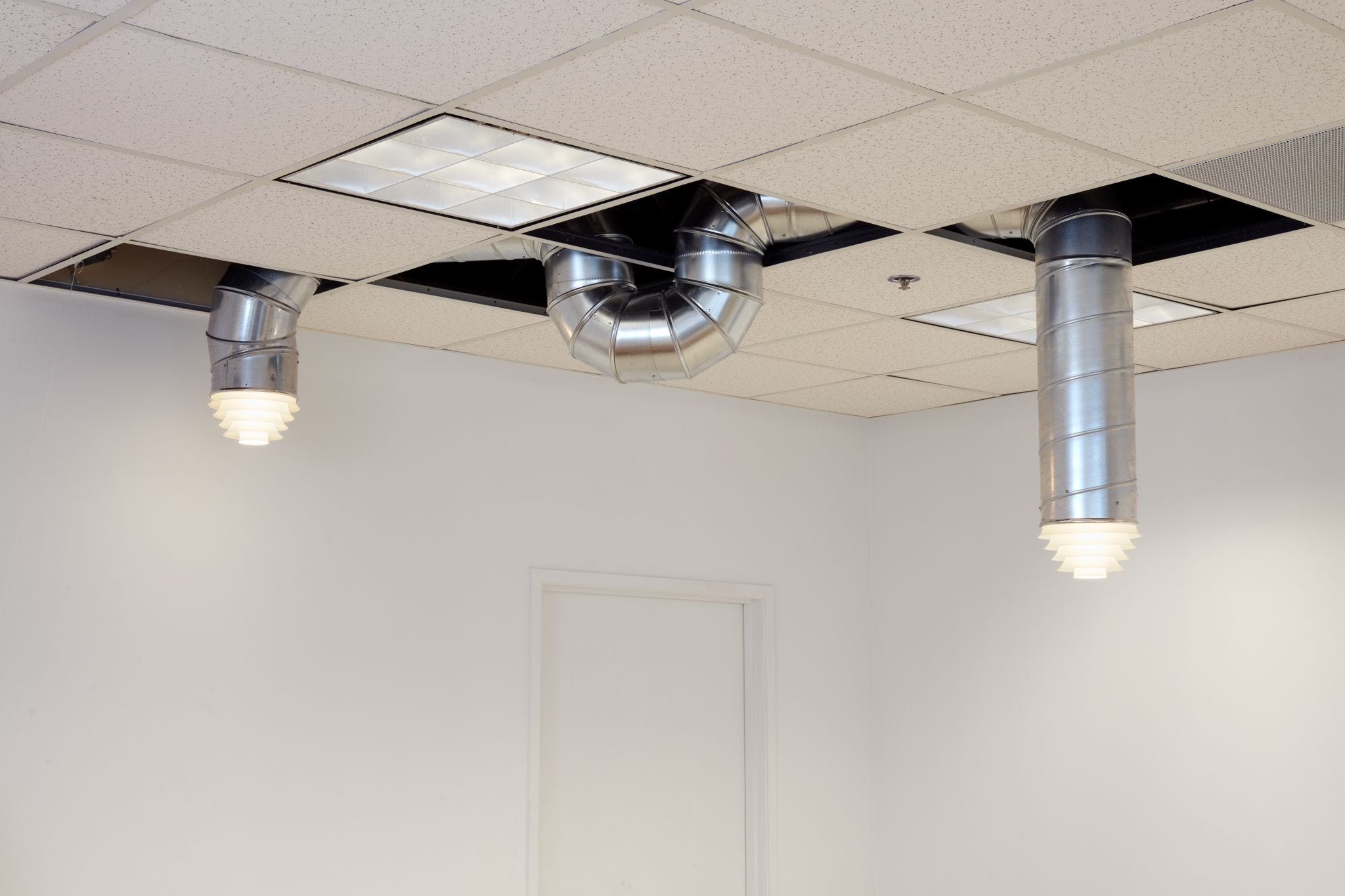
Eli: We care from a curatorial standpoint. We usually find people first and say – we like you, we like your ideas, now we’re going to challenge you to make something for us. Devin’s work is a perfect example of that challenge landing exactly right.
Where do you draw inspiration from outside of the gallery itself?
Eli: Place, always. Our space is in the car corridor of LA, just north of the 10 on La Brea – industrial, strange, auto body shop after auto body shop. There are weird peculiarities and pockets in LA that are still largely unseen. That keeps me curious.
Joseph: The environments I step into shape everything. I pay close attention to the conditions of a space – its scale, light, textures, how people move through it, where it holds tension and where it breathes. Those observations guide decisions from the outset. Not just what we place, but how and why it lands where it does.
Finally, what does taste mean to you?
Joseph: Taste is curiosity. Giving yourself permission to follow the impulse – a Mid-Century Modern Hans Wegner piece right next to an ultra-contemporary stainless steel object. It doesn’t make sense, but it makes sense instinctually. Taste is when you’re fearless enough to do what you want without trend, without outside noise.
Eli: Taste is a sum of your experiences. I grew up going to the Art Institute in Chicago, around artists and designers – I didn’t even think about it at the time, it was just how I grew up. But over time I realized how much those people, my mom, my grandmother, shaped what I respond to. Taste can be learned and experimented with. Taste is yours. Everyone has their own taste profile, and we should be really proud of that.
It was a pleasure to share this conversation with you!
🔥🔥🔥